-

-
Like what you see?
LetsTalkUrl
Let's Talk


A point of view for public sector leaders on the future of public sector cloud integration: why connecting systems securely across multi-cloud and GovCloud, not migrating to it, will define the next decade of digital government.
For most of the past decade, public sector technology leaders have been measured by a single question: how much have you moved to the cloud? Agencies have answered it. Federal, state, and local organizations now run mission-critical workloads in environments such as AWS GovCloud and Azure Government, and they increasingly depend on Software as a Service (SaaS) platforms for everything from case management to citizen engagement.
That progress is real. But it has quietly changed the nature of the problem. The question is no longer whether agencies can operate in the cloud. It is whether they can operate across many clouds at once - securely, consistently, and without losing control.
The migration era rewarded capacity. The era now beginning rewards connection.
A modern agency does not run on one system. It runs on dozens, often hundreds: GovCloud platforms, commercial SaaS, decades-old systems of record, and shared services operated by other agencies. Each was adopted for good reasons. Together, they form an environment that is more capable than ever, and harder than ever to hold together.
This fragmentation carries real consequences:
In a multi-cloud government, the integration layer is the closest thing to a single source of truth and the closest thing to a single point of failure.
It is tempting to treat integration as plumbing: necessary, invisible, and someone else’s job. That view is now a liability.
When systems are connected well, integration becomes the place where policy is enforced, where data is governed, and where citizen services are assembled. It is where a zero-trust security model is applied, where access is controlled, and where every exchange can be traced and audited. The integration layer is where an agency’s intentions meet its reality.
This is why forward-looking leaders are beginning to treat integration as a strategic capability rather than a technical afterthought - something owned, governed, and funded deliberately, with the same seriousness as the systems it connects.
1. From periodic compliance to continuous compliance.
Today, many agencies prove compliance at a point in time, then work to maintain it. The emerging model embeds compliance into the way systems are built and run: expressing controls as code, checking them automatically, and surfacing drift before an auditor or an incident does. Compliance stops being an event and becomes a property of the system.
2. From manual operations to AI-assisted, self-healing systems.
Artificial Intelligence (AI) for IT operations is moving from monitoring toward action. Systems are learning to detect anomalies, predict failures, and resolve routine issues without waiting for human intervention. Over the next decade, more recovery will happen automatically. But in government, where decisions carry statutory and public-safety weight, this progress must be bounded. The goal is not an unsupervised system. It is a system that handles the routine at machine speed while keeping a person accountable for the consequential.
3. From vendor lock-in to multi-cloud sovereignty.
Agencies are right to want resilience and choice. The future favors architectures that distribute workloads across providers while keeping governance, data residency, and security under unified control. Sovereignty here is not a slogan. It is the practical ability to move, recover, and comply without being captive to a single platform.
4. From siloed systems to data that moves securely across boundaries.
The hardest problems in government - fraud, emergency response, public health, benefits delivery - do not respect organizational charts. They require data to move between agencies under clear rules. The next decade will reward those who can share data securely and selectively, treating it as a governed public asset rather than a private departmental holding.
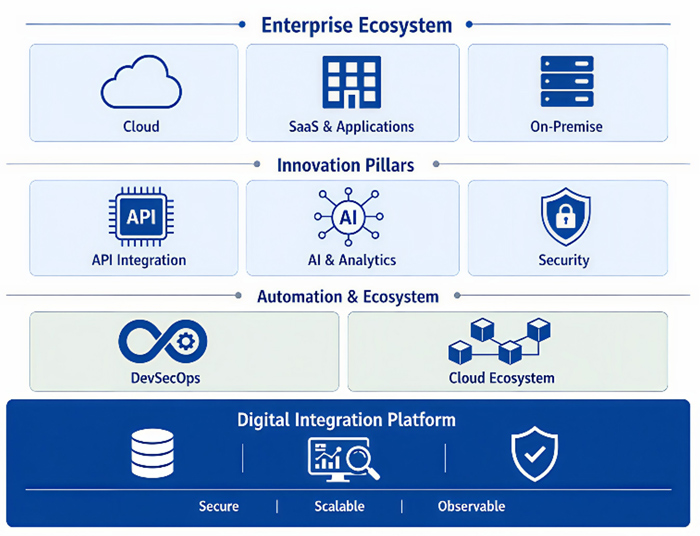
It is easy to describe this future in the language of architecture. But citizens do not experience architecture.
Citizens do not experience your architecture. They experience whether the service works.
When a benefit arrives on time, when an emergency call reaches a dispatcher, when a record is accurate and a system is available, trust is reinforced. When those things fail, trust erodes - and in the public sector, trust is slow to rebuild and costly to lose.
This is the quiet truth beneath every integration decision. Security, compliance, and resilience are not ends in themselves. They are how a government keeps its promises. The agencies that understand this will design for trust on purpose, rather than treat it as a byproduct.
This future does not arrive all at once. It is built through choices made today. Across the public sector, the leaders moving fastest tend to share a few habits.
None of these require waiting for new technology. They require deciding that integration, security, and trust are strategic—and resourcing them accordingly.
The next generation of digital government will not be defined by any single platform or tool. It will be defined by how well agencies connect what they already have, govern it continuously, and adapt as conditions change.
That is a more demanding standard than migration ever was. It is also a more hopeful one. An agency that masters integration is not merely modern. It is adaptable—able to absorb new technology, respond to new threats, and meet new public expectations without rebuilding from scratch each time.
The connected government is not a destination. It is a capability. The work of building it—securely, transparently, and in service of the people who depend on it—is the defining opportunity of the decade ahead.
What is public sector cloud integration?
It is the practice of securely connecting an agency’s cloud platforms, SaaS applications, and legacy systems so that data and services work together. In a multi-cloud government, this integration layer is where policy is enforced, data is governed, and citizen services are assembled.
Why is integration more important than cloud migration now?
Most agencies have already moved core workloads to the cloud. The harder challenge is operating across many clouds at once, securely and consistently. The migration era rewarded capacity; the era now beginning rewards connection.
What is multi-cloud sovereignty in government?
It is the practical ability to distribute workloads across cloud providers while keeping governance, data residency, and security under unified control, so an agency can move, recover, and comply without being locked into a single platform.
What does continuous compliance mean for public agencies?
Instead of proving compliance at a single point in time, continuous compliance embeds controls into how systems are built and run: expressing them as code, checking them automatically, and surfacing drift before an auditor or incident does. It supports frameworks such as FedRAMP, StateRAMP, and CJIS.
What role does AI play in government cloud operations?
AI for IT operations helps detect anomalies, predict failures, and resolve routine issues automatically. In government, it works best as an assistant that handles the routine at machine speed while keeping a person accountable for decisions that carry statutory or public-safety weight.
How does cloud integration affect citizen trust?
Citizens experience whether a service works, not the architecture behind it. Reliable, secure, and accurate services reinforce trust, while failures erode it. Integration, security, and resilience are ultimately how a government keeps its promises.

Ajay Kumar is a technology leader with over 25 years of experience driving large-scale digital transformation initiatives, from initial project implementation to final system integration and enterprise architecture. As principal Technology Architect at Infosys Public Services, he leads the Cloud and Infrastructure practice and is instrumental in helping clients modernize their technology landscapes.
Ajay is known for his strategic vision and collaborative leadership. Ajay excels at aligning complex business objectives with innovative technical solutions. He has a proven track record of spearheading programs that leverage agile methodologies, digital experience platforms, and cloud technologies to foster business innovation.
He is passionate about mentoring and guiding teams, actively sharing his insights on emerging technology trends to build a culture of continuous learning and excellence.

