-

-
Like what you see?
LetsTalkUrl
Let's Talk


Public sector agencies are expanding their use of artificial intelligence and machine learning to improve service delivery, strengthen operations, and support better policy decisions. As these initiatives mature, many agencies are also adopting multi-cloud environments to balance resilience, performance, cost, and regulatory requirements.
That shift creates a new challenge. Machine learning models are no longer deployed in one environment with one set of tools. Teams must manage models across different cloud platforms, data environments, security controls, and operational workflows. Without a disciplined approach, complexity can slow deployment, limit visibility, and increase governance risk.
Machine learning operations, or MLOps, helps address that challenge. MLOps brings together the practices, automation, and governance needed to manage the full machine learning lifecycle. In a multi-cloud environment, it helps agencies deploy models more consistently, monitor them more effectively, and maintain stronger control over performance and compliance.
Many public sector organizations use multi-cloud strategies to avoid overdependence on a single provider and to align workloads to mission, security, and data residency needs. A multi-cloud model may include public cloud platforms, private cloud environments, and hybrid deployments that support different classes of workloads.
This model offers flexibility, but it also adds operational friction. Each environment may have different infrastructure patterns, cloud-native services, identity controls, data policies, and monitoring tools. As machine learning adoption grows, agencies need a way to bring consistency across these environments without slowing innovation.
MLOps gives agencies a repeatable operating model for machine learning. It standardizes how teams build, test, deploy, monitor, and retrain models across cloud environments. It also improves traceability, which is essential when public sector organizations need to explain how models are managed, updated, and governed.
A strong MLOps approach can support unified deployment pipelines, automated model monitoring, drift detection, retraining workflows, and role-based governance. It can also help teams use containers and Kubernetes to improve portability across platforms while maintaining oversight of model performance and infrastructure usage.
For public sector agencies, the value of MLOps lies in combining automation with governance. A modular framework can help agencies move from isolated machine learning projects to a more scalable operating model. Four capabilities are especially important.
1. Model lifecycle automation
Automate key steps from data ingestion to model deployment. Integrate with continuous integration and continuous delivery tools to reduce manual effort, improve repeatability, and support faster releases.
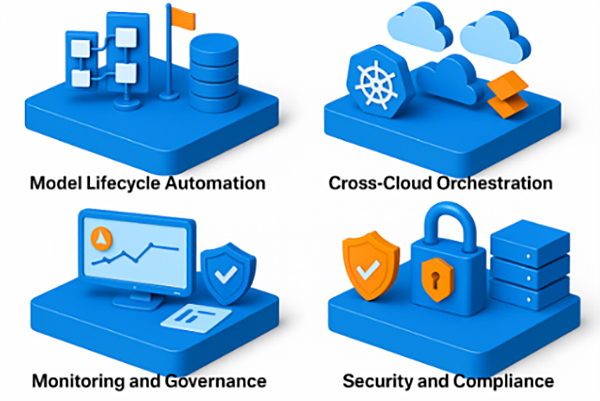
2. Cross-cloud orchestration
Use containers, Kubernetes, and infrastructure-as-code tools to improve portability and consistency across cloud environments. This helps teams manage deployments without creating separate operating models for each platform.
3. Monitoring and governance
Track model performance in real time, detect drift, and trigger retraining when needed. Add access controls, audit logs, and workflow visibility to support accountability and compliance.
4. Security and compliance
Embed encryption, identity and access management, and cloud-native security controls into the operating model. Align processes to public sector expectations around standards, oversight, and risk management.
Consider a state health agency using machine learning to anticipate disease outbreaks. In this kind of scenario, analytics may run in one cloud environment while data storage or integration services run in another. An MLOps pipeline can help keep models current as new data arrives, automate testing and deployment steps, and generate alerts for public health teams when model outputs indicate a potential risk.
Just as important, the operating model can support governance and compliance expectations in regulated environments. That gives agencies a stronger foundation for using machine learning in programs where timeliness, transparency, and trust matter.
As agencies scale artificial intelligence initiatives, the challenge is no longer only how to build a model. The larger question is how to operationalize machine learning in a way that is secure, repeatable, and accountable across increasingly complex environments. MLOps helps answer that question. It gives public sector organizations a practical path to scale machine learning without losing control over governance, compliance, or performance.
MLOps is more than a technical discipline. In a multi-cloud environment, it is a practical capability that helps public sector agencies standardize model operations, improve reliability, and strengthen oversight. With the right framework, agencies can move faster while maintaining control over security, compliance, and performance.
Infosys Public Services brings together cloud modernization, automation, and governance capabilities that help agencies operationalize machine learning with greater consistency and confidence. As public sector organizations continue to modernize, MLOps can play a central role in turning machine learning from isolated pilots into sustainable, trusted, and mission-aligned outcomes.
What is MLOps in a multi-cloud environment?
MLOps in a multi-cloud environment is the set of practices and tools used to build, deploy, monitor, retrain, and govern machine learning models consistently across multiple cloud platforms.
Why is MLOps important for public sector agencies?
MLOps is important for public sector agencies because it helps standardize machine learning operations, improve transparency, support compliance, and reduce manual effort across complex cloud environments.
How does MLOps improve multi-cloud machine learning?
MLOps improves multi-cloud machine learning by creating unified deployment pipelines, automated monitoring, drift detection, retraining workflows, and governance controls across platforms.
What are the benefits of MLOps for government organizations?
Key benefits include faster deployment, stronger governance, better model visibility, improved scalability, and more reliable support for mission outcomes.

Ajay Kumar is a seasoned technology leader with over 24 years of experience driving large-scale digital transformation initiatives, from initial project implementation to final system integration and enterprise architecture. As principal Technology Architect at Infosys Public Services, he leads the Cloud and Infrastructure practice and is instrumental in helping clients modernize their technology landscapes.
Mr. Kumar is known for his strategic vision and collaborative leadership. Ajay excels at aligning complex business objectives with innovative technical solutions. He has a proven track record of spearheading programs that leverage agile methodologies, digital experience platforms, and cloud technologies to foster business innovation.
He is passionate about mentoring and guiding teams, actively sharing his insights on emerging technology trends to build a culture of continuous learning and excellence.

